Most people outside consulting have a vague idea that consulting projects like McKinsey do result mainly in a lot of slides. But what does this slide pack or deliverable actually look like in real life? What is the quality bar these deliverables need to meet? And what ends up in the final report compared to the work that goes in?
In this article, we’ll first discuss what a deliverable is, so the baseline is clear. Then we’ll dissect the final deliverables from a real-life BCG project that were made public because the client was City of Dallas. We’ll look at how the deliverables fit together, what function each one plays, and which best practices you can use in your own work. In addition, we’ll see how the client turned the recommendations into an implementation plan.
And finally, we’ll share some practical tips on how to structure your project and work plan around deliverables to better focus your time and effort.
What is a deliverable in consulting?
Deliverables are the final artifacts that are handed over to the client once a project ends. For consulting firms like McKinsey, BCG, and Bain, these deliverables almost always include at least one slide report that summarizes the process, key findings, and recommendations or next steps resulting from the project.
The typical output is a short executive-level report coupled with a detailed report, created as slides but delivered in PDF form.
As consulting is moving more toward an integrated and results-oriented way of working, deliverables may also include artifacts like Excel models, code, prototypes, mock-ups etc.
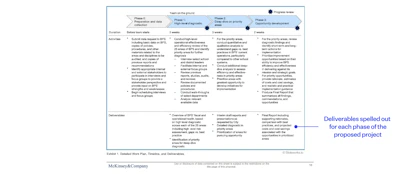
The deliverables are not everything that is created in the project, but instead a specific artifact or set of artifacts that are agreed upon before the project begins. Most often, the exact format is not defined, but the outcomes that should be included are, as you see in the example from McKinsey below.
Dissecting a real-life BCG deliverable
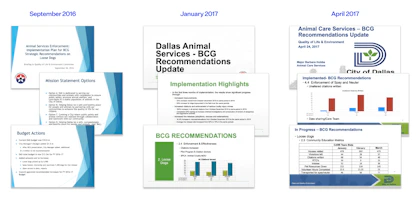
In June 2016, the City of Dallas engaged BCG in an 11-week project to evaluate how to improve public safety while safeguarding animal welfare, specifically, the problem of loose dogs. BCG briefed the City Council on August 30, 2016. Because this was a public-sector engagement, the deliverables are part of the public record (City of Dallas council documents), which makes them a rare chance to study real top-tier consulting output in full.
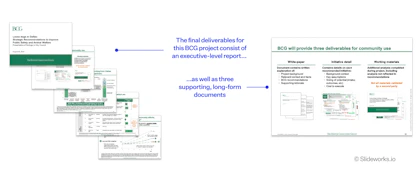
The deliverable handover consists of four parts:
- A short executive presentation
The headline document for decision-makers. It’s tightly storylined and built to be briefed in a single meeting, summarizing key findings and spending the majority of time on recommendations.
- A white paper report
A written, prose version of the full argument. Where the executive deck compresses, the report explains with its own table of contents, executive summary, and detailed narrative.
- A deep-dive deck of findings and recommendations
A longer slide document that works through every finding and every recommendation in detail. This is where each recommendation gets its own slide, its supporting analysis, and its specific initiatives - the proof behind the executive summary.
- A collection of working documents
The models, survey datasets, interview guides, benchmark databases, and source analyses the team built along the way. These are rarely handed to the client as-is, but they underpin every number on every slide.
Let’s jump into each of these in more detail.
1. The short executive presentation
The (relatively) short first deliverable is a slide-based 57-page deck presented to City Council. It represents a classic, best-practice deck with context, key findings, recommendations, and next steps and ends with a Q&A. The main part of the deck is only 35 pages, with some deep-dives ready in an appendix to be pulled up if there are questions.
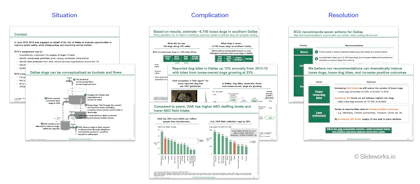
There are several things to note with this deck; first, it illustrates how the situation-complication-resolution framework should be used effectively. The situation (context) sets the scene and places the BCG project in the wider landscape of the City of Dallas’ efforts to create a safe environment. The complication (key findings) then in detail build up what the problem is today and why it is a problem. Finally, the resolution (recommendations) is presented in a to-the-point, prioritized way and emphasizes funding needed and estimated impact of each recommendation so decision makers can easily determine which recommendations to implement.
Second, the deck only picks out the most important findings from the hundreds of slides that make up the working material and detailed report. This is best practice and one of the ways to make your work stand out and seem polished.
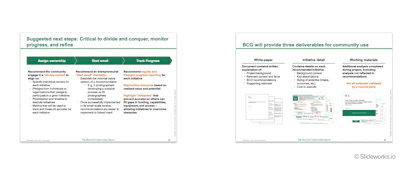
Third, the deck succinctly described suggested next steps and includes a guide to the rest of the deliverables. This helps decision makers get an overview of the results, yet not drown in data and keep the focus on actions to take tomorrow.
2. The white paper report
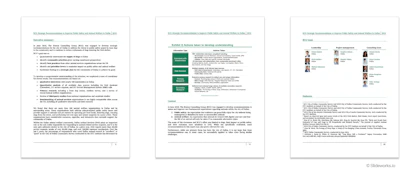
The second main deliverable of the project is a 94-page white paper. This is essentially a written version of the executive deck with a fully written narrative and full-length explanations for each recommendation. Where the executive deck is meant to be presented, this white paper is meant to be read as a stand-alone document on its own.
The white paper also details the approach BCG used in more detail. It especially covers the goals BCG set out to achieve with the project (and which anchor the deliverables), the research and analysis process they used, and the team that helped contribute.
The white paper is a typical deliverable in a public-sector project, but very rare in private engagements.
3. The deep-dive deck of findings and recommendations
The third deliverable of the project is a 115-page dense deck with details on each recommended initiative.
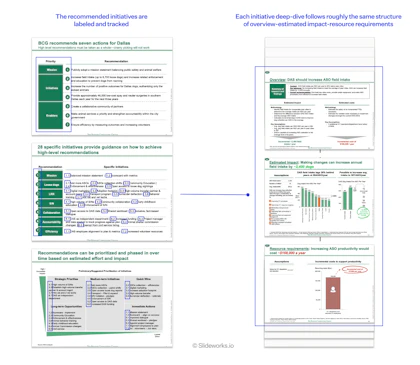
It starts off with an overview of all recommendations, how they are prioritized, and what the estimated funding need is to implement all recommendations. Then it dives into each recommended initiative with an overview of the initiative, background and context, key assumptions that underpin the recommendation, the sizing of the potential, and the cost to execute the initiative.
Each recommended initiative is numbered and tracked against the main overview. In addition, each section follows a fairly stringent structure, so it is easier for the reader to digest and compare initiatives.
The deep-dive deck has two functions; it summarizes findings systematically to encourage faith in the recommendations and that the consulting team has done their job, and it serves as a blueprint and background for the people implementing the initiatives. Because the recommendations are data-driven and the data is clearly shown along with key assumptions, it’s easier to convince stakeholders and the people on the ground that the recommendations are sound and should be followed.
4. The working documents
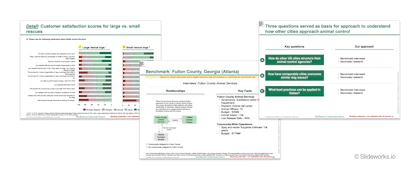
The final piece of the deliverables for this BCG project is the long working documents file. This 137-page deck contains a mix of internal and external data, conclusions, methodology, and process slides and BCG puts a disclaimer on it upfront to indicate that this is working material and is not all verified.
This type of working documents deliverable is quite unusual in regular consulting projects, but reflects the fact that this particular project was both a public-sector and pro-bono engagement where BCG has wanted to leave the client with as much information to continue on their own as they can.
Practical tips for your own deliverables
You don’t need a top-tier consulting badge to apply these patterns. Start here.
- Draft your deliverables at the beginning of the project, not the end: This is perhaps the single most important tip to both save you time and create better end deliverables. Spend ½-1 day at the beginning of a project to draft the end-deliverable. Start with what the best outcome of the project will be (e.g., a yes on a business case, initiatives set in motion, next steps of the project approved) and put that “ask” on a slide. Then draft the sections of your deliverable that lead up to that ask. This will typically follow an SCR or similar framework, or take a deliverable from a similar, completed project and use that as the skeleton. You don’t need to fill in any slides or know what each slide should cover, but have the main elements in there like e.g., “project context”, “market dynamics”, “past initiatives and results” or similar.
This will help you understand what you need to have covered during your project to present a complete deliverable at the end, so you can both allocate adequate resources and don’t end up with two days left and a gaping hole that you forgot to include.
- Fill in your deliverable as your project progresses: Use the skeleton draft deliverable as your “bucket” to fill in your findings as you go. Don’t worry too much about storyline and consistency but instead just add any main findings or results to the deliverable draft deck as they come.
- Add a scope slide: State what you set out to answer and what you deliberately excluded. It signals control and pre-empts “but what about…” questions.
- Source every number on the slide: Put a source line at the bottom of any slide with data. If you can’t name the source, you’re not ready to present the number - and if a number came from an AI tool, verify it before it goes in.
- Separate the point from the proof: Keep the executive deck to one message per slide, and move detailed calculations, assumptions, and per-recommendation analysis into the deep-dive and the appendix.
- Cut, cut, cut: Finally, do ruthless cuts on what ends up in your deliverables. Open a new presentation and cut any slide from the main deliverable that you’re not 100% sure is absolutely necessary. Move all the cut slides into the new presentation so they are not “lost”. Then go back and re-read your deliverable and see if anything has to be moved back in.
- Read your slide titles aloud in sequence: Once your deck is drafted, read only the slide titles in sequence. If they don’t tell a coherent story, your storyline isn’t finished. Rewrite each title as an action-oriented takeaway.
- Focus on action: Don’t do a step-by-step summary of what has happened or include all aspects of an analysis. Instead, focus on key findings that move the audience’s perception of the situation and on recommendations and actions that will help change the situation. This alone is one of the subtle but highly impactful skills used by McKinsey and BCG consultants to make their decks feel “better”.
Conclusion
A real top-tier consulting deliverable is not “just” a collection of many, heavy slides. Nor is it simply a summary of everything that has gone on in the project. Instead, it’s an action-oriented, results-focused report aimed at moving decision makers in one direction or another.
The fastest way to internalize these patterns is to study full, worked examples and then build from structured templates that already encode the storyline. Pick one upcoming deck, pick mainly the slides that focus on recommendations, results, and next steps, rewrite its titles as conclusions, add a scope slide, and move everything that doesn’t feel strictly necessary to an appendix. That alone will move your output noticeably closer to the top-tier standard.
Build consulting-grade deliverables faster
Try the Slideworks PowerPoint add-in: the full slide library inside PowerPoint for teams, with smart search and exclusive new slide drops.
Try the add-in now