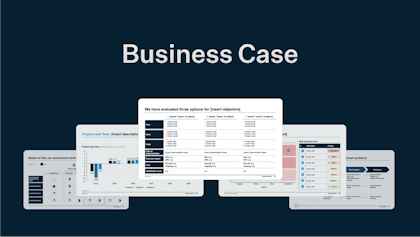
Business cases are a core part of most corporate workplaces. They are used in virtually all functions and industries when decisions have to be made on whether or not to invest resources (time and money) into a new product, IT system, manufacturing plant etc. The successful business case must therefore convince an executive audience that a specific investment deserves budget, people, and time, and it’s judged on the strength of its argument and the credibility of its numbers.
To build a successful business case requires a combination of asking the right questions, finding the appropriate data, and packaging it all in an effective structure, outputted as either slides or a text document. For the packaging part in slides, there are several tools available that can support this work. In September 2026, the tools for building a great business case presentation fall into four categories: consulting-grade templates, financial modeling tools, PowerPoint add-ins, and AI slide generators.
In this article, we recap what a business case answers and how it is built, define what an executive-ready business case presentation contains, compare the four tool categories against that standard, and give our recommendation as ex-McKinsey, BCG, and Bain consultants on how to combine them.
Which key questions does a business case answer?
Before we dig into the tools, let’s briefly recap what a business case actually is and the questions it answers.
1. Why do we need to act, and why now?
The situation the organization is in, the problem or opportunity that has appeared, and the cost of leaving it alone. This is the part decision-makers must accept before anything else will land. If they dispute the problem, they will dispute the solution.
2. Which option should we choose?
The realistic ways of addressing the problem, always including doing nothing, compared against the same criteria: cost, benefit, risk, time to value, and fit with strategy. The recommendation is the output of that comparison. Presenting a recommendation without the comparison turns the business case into a pitch.
3. What will it take, and what will we get back?
The investment required, the returns expected and when they arrive, the assumptions underneath both, and the risks that could move the numbers. This is the answer the finance function reads first and tests hardest.
Note that a business case and business plan are two separate types of documents. A business plan describes how a business will operate over time, while a business case argues for one specific decision. This means the two should be structured in very different ways and carry very different arguments.
How do you create a business case?
You typically build a business case through a systematic process: