Why is strategy important in business?
In the hectic environment of everyday business operations, taking time to think through and put a strategy on paper can seem like a time-sucking effort with little immediate impact on the top- and bottom-line. Executives can sometimes feel that the company strategy is clear enough and doesn’t need to be explicitly stated.
However, the graveyard of failed businesses is littered with companies that lacked a clear and deliberate strategy. Almost invariably, the clarity and execution of a strategy is what separates winners from losers.
To be more specific, here’s why a good strategy is paramount to succeed:
1. Framework for resource allocation
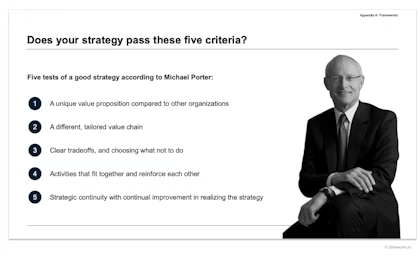
As Michael Porter, one of the grandfathers of modern strategy thinking, writes: “The essence of strategy is choosing what not to do”.
A good strategy acts as a practical framework for making decisions on how to allocate resources on a day-to-day, month-to-month, and year-to-year basis. If you have outlined what you want to focus on, what is important to build your competitive advantage, and how this flows into initiatives, people, and organizational structures then it’s easy to say “yes” or “no” when faced with requests for money or people for new projects and changes.
Conversely, a bad strategy or no strategy at all leaves managers and employees without this clear framework and more often than not too many projects and initiatives are started, teams lose focus, and the march toward improving competitive positions is slowed.
2. Yardstick for measuring progress
A good strategy also means there is a clear goal and an explicit and congruent way of measuring progress towards that goal. If you don’t have a clear picture of where you want to go it is hard to know if you’re on the right path.
However, I’ve seen many executives make the mistake of thinking that any progress is good progress when measuring success.
An example of this was an non-profit I worked with several years ago. Here, their overall goal wasn’t maximizing profit or top-line, but instead helping as many children in need as they could through fundraising. But they lacked a clear strategy that defined that fundraising goal more granularly and prioritized efforts systematically. The result was that every employee was doing a myriad of fundraising projects and had no system for discerning between opportunities, leading to almost everyone feeling like they were spread too thin and little growth in funds raised.
By translating the generic and fluffy goal of “helping as many children as possible” to a more specific and measurable goal of “getting the most funds raised”, the non-profit was able to streamline efforts, say no to fundraising projects and random ideas, and finally grow funds raised.
Many companies without strategies or with simple plans fall into the trap of setting too generic goals and miss the opportunity to maximize resources for the most effective goal. A good strategy instead allows a company to ask; are we succeeding at the right metrics?
3. Aligns incentives and behavior
Creating and putting a strategy on paper also forces a conversation of incentive structure. As Charlie Munger famously said: “Show me the incentive and I’ll show you the behavior”.
A strategy outlines where you want to go and how you want to get there. This cascades into the behaviors you need to foster in the organization to achieve these aims. A good example of incentives and behaviors is in a cost optimization vs. innovation situation. If your strategy shows you to be in an efficiency game where reduced prices and/or costs are the competitive advantage, then you want KPIs in place that incentivize cost cutting. This can be e.g., measuring managers on their profit margins, head count or similar.
However, if you’re in an innovation environment where competitive advantage comes from being first or best with new technologies, products, or features, then the same cost cutting KPIs would be detrimental to success. Here instead you want employees to dare take risks to build something that might fail. You want departments to have research budgets and teams to be able to invest and follow promising leads.
4. Forces deliberate competitive advantage
Putting a strategy on paper forces you to articulate your playing field and your competitive advantage. It also forces everyone to agree on what your competitive advantage specifically is. Even if this can feel trivial, I’ve witnessed countless companies where executives were sure they were all in agreement and didn’t need to state their unique selling points explicitly, only to find that they all had slightly different notions of what they were once they were forced to say them out loud.
A good strategy allows you to deliberately identify, build, and iterate on your competitive advantage. And it sets up a foundation so this competitive advantage can seep into every part of the company and ensure all initiatives and actions work to enforce this advantage.
5. Manages risks in a cohesive way
Finally, a good strategy highlights areas of potential risks and lays out mitigation strategies for these risks.
You may feel you have enough with just a simple risk mitigation plan, but this misses the bigger picture and means you may accidentally have individual mitigation strategies that undermine a greater goal.
Without a strategy you are essentially flying blind in deciding which risks are worth focusing on and what different mitigation plans mean for the entire organization. Embedding risk management in a strategy allows you to correctly and intentionally rank risks and decide between mitigation initiatives.
How is strategy different from a plan?
One of the most common misconceptions I encountered at Bain was the equation of strategy with planning. While related, they're fundamentally different:
Strategy is about choices:
- Determines where you will play and how you will win
- Focuses on creating sustainable competitive advantage
- Makes explicit trade-offs between competing priorities
- Provides guiding principles for decision-making
Planning is about execution:
- Details how to implement strategic choices
- Focuses on operational effectiveness
- Allocates resources and sets timelines
- Provides specific action steps and metrics
As Jack Welch, legendary former CEO of General Electric, allegedly said: “Strategy is not a lengthy action plan. It is the evolution of a central idea through continually changing circumstances."