Product Strategy Deck: The MBB Consultant Cheat Sheet
Ex-McKinsey, BCG, and Bain consultants share their top tips for building standout product strategy decks. A practical cheat sheet for product leaders.
Mar 11, 2026

"Differentiation is the essence of strategy" (1). You earn profits not just by what you do for customers but by doing it better or differently than competitors.
A competitive analysis systematically evaluates your competitors' strengths, weaknesses, strategies, and market positions. It reveals where you can stand out and how to outmaneuver rivals.
Drawing from best practices from top consulting firms like McKinsey, BCG, and Bain, this post will walk you through a structured framework for competitive analysis and a practical step-by-step approach to execute it. The goal is to equip you with a simple playbook to analyze your competition and form winning strategies for your business.
While customers drive your success, competitors shape your opportunities. A competitive analysis is a structured evaluation of competing businesses to uncover their strategies, strengths, weaknesses, and market positioning. It answers critical questions to refine your decisions and avoid costly missteps:
The following framework, adapted from BCG and Mckinsey's approach, outlines the main elements that should go into your competitive market analysis.

As you can see, the competitive analysis framework consists of three main parts:
How do you turn the above framework into a comprehensive strategy?
Let's go through the process step-by-step:
Start by clarifying why you are doing the competitive analysis and what questions you need to answer. Are you developing a new product strategy and need to know how it stacks up against competitors? Entering a new market and unsure of the competitive landscape? Or trying to find weaknesses in a dominant competitor to exploit? Defining clear objectives will focus your analysis on what matters most.
For example, your goal might be "to determine how we can increase market share in Segment X against Competitors A and B" or "to anticipate how Competitor Y will react if we cut prices."
From the objectives, define the scope: which product lines, markets, or geographic regions will you analyze? Also, decide the time horizon (current snapshot vs. 3-year outlook). Establishing a clear scope prevents your analysis project from ballooning.
(A tip from experience: link the scope to your business problem. If you're concerned about a startup disrupting your niche, include emerging players, even if they're small. If you're focusing on one region, you might not need to analyze competitors' global operations, just their presence in your region.)
Key output of Step 1: A clear project brief or set of questions that the competitive analysis must answer, as well as the scope of your analysis.
Begin your analysis by painting a clear picture of the industry in which you and your competitors operate. This industry overview provides context for interpreting each competitor's performance. It ensures your competitive analysis isn't done in a vacuum but rather considers the winds (tailwinds or headwinds) affecting all players in the industry.
Note: You don't necessarily need to do a full market analysis here, but it is important to identify the main forces shaping the market you are in.
Here are a few common components to consider when analyzing your industry landscape:

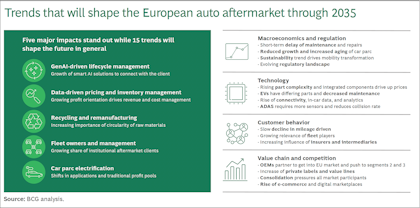
BCG slides summarising key industry trends impacting the European auto aftermarket
With the industry backdrop in mind, zoom in on the competitive landscape. This means identifying who your competitors are and understanding their positioning in the market relative to each other.
To find competitors, put yourself in your customer's shoes: What options would they consider? Use multiple sources for your research:
Make a comprehensive list of competitors. Include direct competitors (those offering similar products/services to the same customers) and important indirect competitors or substitutes. Don't forget new entrants or startups that could become threats.
(It's easy to get caught up analyzing the whole world here – so focus on the most relevant competitors)
For each major competitor you identify, try to map out the following two dimensions:

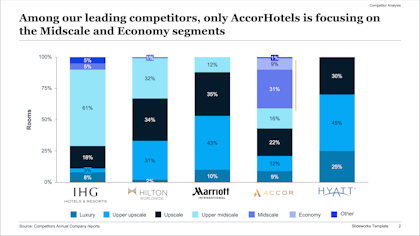
Competitive analysis slide highlighting how various hotel chains target distinct customer segments – Slideworks template
Once listed, prioritize your longlist of competitors by relevance – typically based on market share, customer segment overlap, or threat level.
It's often effective to prioritize into tiers (e.g. Tier 1: key direct competitors; Tier 2: secondary or niche competitors; Tier 3: emerging or indirect players). This prioritization will guide how you where to focus in the subsequent steps (major competitors warrant deeper analysis). Ensure you also profile your own company for an apples-to-apples view.
After surveying the broad landscape, the next step is to deep-dive into individual competitors (typically the top 3-5 ones identified in step 2). Start by collecting as much relevant information on each competitor as possible.
Use both primary and secondary research for a complete picture.
For each competitor, try and collect data on the following key areas:
(Don't worry about drawing conclusions just yet—at this stage, focus on getting accurate and up-to-date facts.)

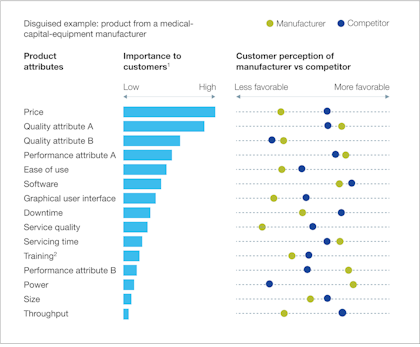
McKinsey example: Customer perception data can reveal which product attributes pay off
Organize the data you collect in a competitive analysis spreadsheet or template for consistency. One approach is to create a table where each row is a competitor and columns cover categories like Financial Performance, Product/Services, etc.)
The result of this step should be a comprehensive profile for each competitor.

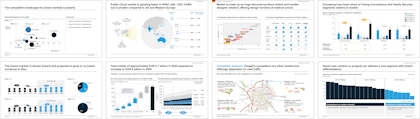
Various competitive market analysis slides - Slideworks template
With your rich competitor profiles in hand, it's time to synthesize how your company stacks up. A classic and effective framework for this is the SWOT analysis – examining Strengths, Weaknesses, Opportunities, and Threats.
In the context of competitive analysis, you'll be considering your own organization's SWOT relative to competitors, as well as noting competitors' SWOT profiles to understand their relative advantages/disadvantages.
Here's how to break it down:
The outcome of this step is a clear understanding of where you stand versus competitors:
You have now gathered a wealth of data and identified your SWOT relative to the competition. Now it's time to translate these insights into strategic implications for your business. In essence: What does all this analysis mean for how we should compete and win?
This involves prioritizing areas of opportunity, shoring up vulnerabilities, and formulating the broad strokes of your competitive strategy.
You can approach this by following four steps:
Leverage the strengths and opportunities from your SWOT to pinpoint where you have the best chance to outperform competitors. These are the arenas to double down on. For example, suppose your analysis finds that your product significantly outperforms competitors' on a feature highly valued by a growing customer segment – that's a space to play hard.
Another area to win might be customer experience – if competitors are weak in service, and you excel there, make it a pillar of your strategy (e.g. extending support hours, personalized services, loyalty programs). Differentiation is key here – the analysis should reveal what makes you unique in a way customers care about. Formulate how to exploit that uniqueness.
Equally important is deciding how to deal with your weaknesses and external threats. Some gaps you may choose to fix; others you might decide to avoid or minimize exposure to. If the analysis flagged a significant weakness, it likely becomes a strategic priority to address it.
Sometimes, the analysis might also suggest exiting or avoiding certain battles: if a competitor dominates a segment where you are weak and it's not profitable to compete, you might divert focus to other segments. In strategy, knowing what not to do is as important as knowing what to do.
Now synthesize a coherent strategy. This may involve classic strategic choices:
With directions in mind, outline concrete strategic moves. These could include:
For each strategic idea, tie it back to the analysis: Why do this? Because the analysis showed X about the competition, and this move exploits or responds to it.
By the end of this step, you should have a clear narrative of how your company can win in the market.
It might sound like: "Given the competitive landscape, our best play is to leverage [our strength] to capture [specific opportunity], while fixing [key weakness] so that Competitor A's advantage is nullified. We'll avoid head-on confrontation in [area] where Competitor B is strongest, and instead focus on [alternative angle]. Concretely, this means executing [Strategy 1], [Strategy 2], and [Strategy 3] over the next 1-2 years."
This provides direction for the next step: turning strategy into an actionable plan.
The final piece of the puzzle is developing clear, actionable recommendations and a roadmap for implementation. Think of this as the executive summary of what needs to happen next – targeted initiatives based on the competitive strategy implications above, complete with suggested timing and resources.
Here's how to formulate this:
Prioritize Strategic Initiatives: From the various strategic responses considered, select a focused set of initiatives that will deliver the most impact. It's tempting to attempt everything, but a successful strategy is about focus. Identify 2–5 key initiatives that align with winning opportunities or critical gap-filling.
Each recommendation should be SMART (Specific, Measurable, Achievable, Relevant, Time-bound) so that execution can be tracked.
For example, your top recommendations might be:
Implementation Roadmap: Lay out a high-level timeline (next 12-24 months, for example) for these initiatives. What should happen in the short term (next 3-6 months) versus medium term (6-18 months)?
Plot the sequence: certain steps may need to precede others (for instance, improving the e-commerce platform may be a prerequisite before a big online marketing push). If helpful, break it into phases:
Resource Allocation and Responsibilities: Provide guidance on what resources (budget, team, technology) will be needed for each initiative and who should lead it. Competitive strategies often fail in execution when no clear owner is assigned.
Establish Metrics and Monitoring: Finally, recommend setting up a competitive intelligence and performance monitoring mechanism. For example, "Track market share on a quarterly basis in our key segments and benchmark customer satisfaction vs. Competitor B's." Ensure there is a feedback loop: as you implement changes, measure outcomes (sales growth, customer acquisition, etc.) and keep an eye on competitor reactions or new developments. Competitive analysis is not a one-and-done project; it's an ongoing discipline.
By delivering concrete next steps, an implementation roadmap, and resource guidance, you turn analysis into action.
For example, a polished recommendation might read:
"Recommendation 1: Develop and launch a mid-tier product by Q4 to capture price-sensitive consumers migrating from Competitor X. Rationale: Competitor X's withdrawal from the mid-tier segment (per our analysis) leaves a market gap we can exploit. Action Plan: R&D to fast-track development (team of 5 engineers, $2M budget, led by VP Product). Beta test in one region by Q3, full launch Q4. Marketing campaign targeting Competitor X's customer pain points begins Q4. Success Metric: Achieve 10% market share in the mid-tier segment by Q2 next year. Contingency: If Competitor X re-enters with discounts, emphasize our superior features and consider limited-time promotions."
This level of specificity makes it clear what needs to be done and why, instilling confidence in execution.
With actionable recommendations in hand, you have effectively translated competitive analysis into a strategic game plan. The leadership team can now move forward with alignment on priorities, armed with deep insight into the competitive playing field.
A well-crafted competitive analysis requires both the right content and structure. Basing your plan on a proven framework and presentation template can accelerate the process, help maintain the proper structure, and offer ideas for designing and organizing various slide types.
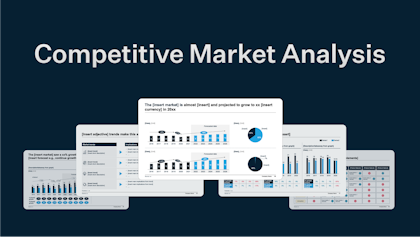
Our PowerPoint Competitive Market Analysis Template follows the approach discussed here. It features 217 template PowerPoint slides designed by former McKinsey, Bain, and BCG consultants. Additionally, it includes three examples of what an effective real-life competitive analysis can look like.