Strategy

How to Write a Market Entry Report: The Structure McKinsey, BCG, and Bain Use

Updated: Apr 8, 2026
How to Write a Market Entry Report: The Structure McKinsey, BCG, and Bain Use
DISCLAIMER OF AFFILIATION: Slideworks is an independent entity and is not affiliated or endorsed by, or in any way officially connected with BCG, McKinsey or Bain. All references to these companies are for informational or comparative purposes only and does not imply any association with or endorsement by the aforementioned companies.

Often companies want to expand and grow into new markets. However, deciding which new geography or market to enter is almost always difficult and needs analysis, regardless of company size. There are many different things to consider; which market is growing, which market fits the best to our strengths, where do we face competition and where do we not, where do customers match what we know, what are the macrotrends influencing each market etc.

A well-structured market entry report gives decision makers exactly what they need: a clear, comparable view of each candidate market and a defensible recommendation. In our experience at McKinsey, BCG, and Bain, this type of report follows a consistent structure across projects. It is not improvised from scratch each time. The same six-section framework reappears because it works, building from context to evidence to conclusion in the exact order decision-makers need.

In this post, we'll walk through that six-section structure, cover the five best practices that separate a rigorous market comparison from a data dump, and highlight the most common mistakes to avoid.


What is a market entry report?

A market entry analysis report is a structured presentation that gives decision makers the information they need to compare potential markets or geographies against consistent criteria and to judge which ones are most attractive to enter or prioritize.

This type of report has many different names, which can sometimes make it difficult to find great examples. The most common we’ve come across are market report, market entry report, market comparison report, market study, or market entry analysis. However, they all follow the same common structure, as we’ll see below.


What is the difference between a market entry analysis and a go-to-market strategy and competitive market analysis?

The market entry report in our lingo is also distinct and different from two related types of presentations; the go-to-market strategy and the competitive market analysis

The go-to-market strategy is a more all-round strategy deck, covering how you’ll get your product to market in terms of your sales strategy, distribution setup, marketing strategy etc. It often includes some initial thoughts on which markets and geographies to target first.

The competitive market analysis is a single-market study, meaning you go deep on a market analysis in terms of customer segments, growth dynamics, trends, competitive landscape etc. This type of report is used in many different contexts as both input to a GTM or broader business strategy, understanding of a market in-depth, and as a continuation of the initial market selection.

The market entry analysis in comparison is a multi-market study. It will rely on the same core criteria used for a GTM strategy or competitive market analysis, but often stays more high-level and is used to decide and prioritize between multiple potential geographies. You may find the multi-market comparison is done first to determine where to go next, after which a detailed GTM strategy or market study is conducted to decide exactly how to succeed in the new market.

Note that in the first two types of decks, the word “market” often means both a geography and customer segment, while “market” in a market entry report is most often a new geography.

The market entry analysis output is almost always slide-based rather than a written document. This is deliberate. The comparison-heavy nature of the content, where multiple countries are evaluated across the same dimensions, suits a visual format where readers can scan and contrast rather than read sequentially.

The report is typically between 30-100+ slides depending on the number of markets and the depth of analysis required. Often, the main conclusions are shared in a separate executive summary deck or as a short section upfront. In addition, the systematic nature of the comparison makes it easier to digest.


When do you need a market entry report?

Three scenarios drive most market entry analysis work:

  • Market selection: A company is considering entering a new geography and needs to identify which market offers the best conditions for success. The report narrows a long list of candidates to a ranked shortlist with a clear recommendation.
     
  • Market prioritization: A company already operates across multiple markets and needs to decide where to focus resources and investment. The report evaluates existing markets against each other and recommends where to double down.
     
  • Competitive intelligence: A company wants to understand how competitors operate in different geographies to reveal their expansion patterns, strengths, and vulnerabilities and to identify where whitespace exists.


The six-section structure for market entry reports used by McKinsey, BCG, and Bain

In our experience, multi-market comparison reports typically follow a six-section structure that effectively moves the reader from context to conclusion.

Depending on the situation, some reports may have more or less emphasis on each section, or skip some altogether. However, if you have thought through each of these (even if you decide to not include them in your final deck), you’ll be sure to have all bases covered and a good and defensible recommendation at the end of your report.
 

Section 1: Introduction and market objectives

The opening section sets the scope of the entire report. It defines which markets are being evaluated, why they were selected for analysis, and what the strategic objectives behind the exercise are. It's a short section, often just a couple of slides, but helps frame the overall presentation.

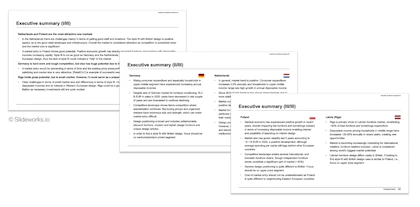
These slides sometimes double as your executive summary deck, if you want to pass around the main findings.


The introduction often serves as the executive summary and frames the overall analysis.

Section 2: Market overview (macro-level)

Before going country by country, a market entry report typically establishes the overall market context. This section covers the macro-level picture: total industry size, growth trajectory, economic conditions, and the key forces shaping the market as a whole.

The purpose is to give decision-makers a shared reference point before the comparison begins. If you are comparing six European markets for a payments software company, the reader first needs to understand the overall European payments landscape - its size, growth rate, customer segments, and key players - before individual country differences become meaningful.

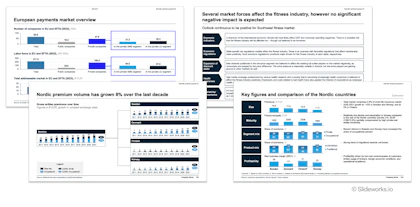
Most market reports begin with a high-level market overview to understand broader dynamics before jumping into specific geos.

This section typically draws on industry reports, Eurostat, OECD or equivalent statistical databases, and your own team analysis. Be explicit about your sources - credibility in a market entry report is partly a function of data quality.


Section 3: Preliminary market screening

Now you want to frame the specific countries you’ll be looking at with an initial filter. The goal is to narrow a broad set of potential markets down to a shortlist of candidates worth deeper investigation.

The screening uses a set of consistent, business-critical criteria to categorize markets quickly. The criteria should be aligned with all decision makers and stakeholders beforehand, so everyone agrees on what is most important. The purpose of this upfront definition and alignment is two-fold; first, it makes it much easier to find and analyze the appropriate data for each country or market (so you don’t boil the ocean) and second, it means no decision maker feels you have overlooked key factors when prioritizing markets and therefore tend to support your final conclusion and recommendation more strongly. 

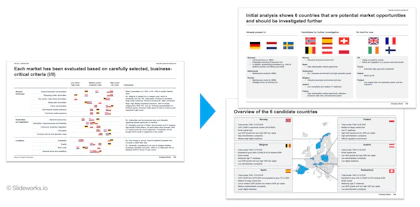
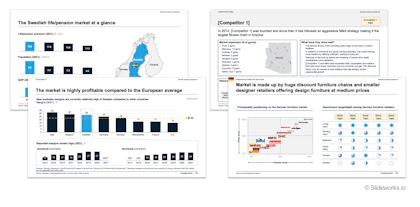
Examples of screening slides.

This section overall allows you to frame which criteria are important for market selection, present the main countries you’ll deep-dive in, and avoid questions on “why not country X” since you’ve already shown why these markets have been deprioritized. 

This is also where a high-level summary comparison often appears; a single slide that shows all candidate markets side by side with their headline characteristics, so the reader can orient themselves before the detailed analysis begins. By including the “conclusion” upfront, it helps the reader process the mass of data that follows with an overall frame of reference.
 

Section 4: In-depth market evaluation and analysis

This is the main body of the report and typically accounts for the majority of the slide count. Each candidate market receives its own deep-dive section, typically structured around the same five sub-topics:

  • Market size and growth potential: Total addressable market, growth rates, segment breakdown
     
  • Customer demand and behaviour: Who the buyers are, what drives purchasing decisions, demand patterns
     
  • Competitive landscape: Key players, their positioning, market share, and competitive dynamics
     
  • Regulatory environment: Legal requirements, compliance complexity, government initiatives
     
  • Risks and opportunities: Country-specific factors that could accelerate or impede entry

The non-negotiable rule here is structural consistency. Every country must be analyzed using the same framework, in the same order, with the same metrics where possible. Keeping a stringent structure allows for easier digestion and comparison. If you analyze the regulatory environment for Germany but skip it for Spain, you have created a gap that decision makers will notice and trust will erode accordingly.
 

The deep-dive sections will depend on the specific type of market entry report you're doing and can range from very quantitative to quite qualitative.

The exact dimensions you choose to deep-dive on will differ depending on your particular situation. You may want to go deep on competitors, backing it up with info from actual store visits or profiling key competitors. Or you may want to focus on regulatory restrictions and the opportunities your particular company and setup have.

Whether you go deep in one dimension or the other, stick to overall best practice slide writing techniques. In particular, since the report is often very long, make sure you use action titles where the slide headline communicates the key finding, not just the topic. "Sweden is a small market but attractive from a digital perspective" is more useful than "Sweden market overview." The reader should be able to navigate the report using headlines alone and arrive at the core conclusions without reading every bullet.


Section 5: Market attractiveness and selection

Once you’ve deep-dived into each market you want to get back to the high level and make your overall recommendation on market attractiveness and potentially which market(s) to enter first. This, in other words, is your synthesis section. It takes the findings from the individual country analyses and translates them into a structured comparison - scoring or ranking each market against the evaluation criteria to support a clear recommendation.

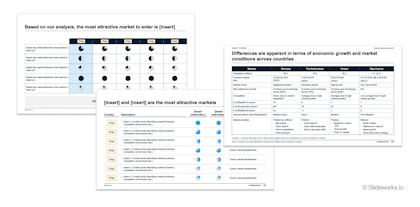
The most common format here is a scoring matrix: evaluation criteria down the rows, markets across the columns, with visual indicators (flag icons, traffic light ratings, or positional markers on a low-to-high scale) showing how each market performs on each dimension.

Examples of recommendation slides.

The scoring matrix should be grounded in the evidence from Section 4. Each position on the matrix should be traceable back to a specific finding in the individual country analysis. If a market scores low on regulatory complexity, there should be a slide in the country deep-dive that explains why.

This section typically ends with an explicit recommendation on which market or markets the analysis supports pursuing, and in what order of priority. A market entry analysis that concludes with "all markets have merit" has not done its job.

Note that this section sometimes comes at the beginning of the report to follow a pyramid principle storyline. You can see examples of this in our full Market Entry Analysis template case studies. Regardless of placement in the final deck, the analysis will be done after the deep-dives and acts as a summary and synthesis of main findings.


Section 6: Definitions and methodology

This section documents the research approach, data sources, and how the evaluation criteria were defined and weighted. It’s sometimes part of the main report and sometimes just an appendix in the full deck.

A well-documented methodology section does two things. First, it builds credibility - decision makers can see how the analysis was constructed and challenge assumptions they disagree with. Second, it protects the analytical team - if findings are challenged six months later, the methodology section is the record of what was done and why.

At minimum, this section should cover the following: the research methods used (desk research, expert interviews, site visits), the primary data sources, how criteria were selected and defined, and any important caveats or data limitations.


Five best practices for comparing markets

The structure above is the typical way a market entry report is built. However, to really lift the deck to the next level and both impress and convince stakeholders, there are some best practices that are useful to incorporate.

  1. Decide upfront what matters from a business perspective: Before you begin gathering data, define the criteria that are actually relevant to the strategic decision at hand. Different business models, products, and competitive positions require different evaluation lenses. A payments software company entering European markets cares about digital infrastructure and regulatory complexity. A furniture retailer cares about retail park availability and consumer brand orientation. Get the criteria right first, then collect the data.
     
  2. Use the same parameters and metrics across all markets: Comparison only works when you are measuring the same thing. If you use CAGR for one market and absolute growth for another, the analysis is not comparable. Define your metrics upfront and apply them consistently across every market in scope.
     
  3. Use the same or similar sources across markets where possible: Eurostat, World Bank, and Euromonitor exist precisely because they provide consistent methodologies across geographies. Where consistent sources exist, use them. Where you have to use national sources, flag it explicitly. Decision makers need to know when they are comparing apples to apples and when they are not.
     
  4. Structure each country analysis identically: Use the same sections, in the same order, with the same layout for every country. This creates the visual and structural consistency that makes comparison effortless. When the reader arrives at the Germany slides having already seen Sweden and the Netherlands, they should immediately know where to find each type of information.
     
  5. Include an overall conclusion: The market entry analysis exists to support a decision. That decision should be made explicit in the report - not left implicit in the data. The synthesis section should state clearly which markets the analysis recommends, in what order of priority, and on what basis.

These five best practice principle separate a rigorous market comparison from a data-heavy slide deck that leaves decision makers more confused than when they started.

Common mistakes to avoid

Letting data availability drive criteria selection. 
The markets where data is hardest to find are often the most interesting. If you define criteria based on what is easy to measure, you will build a systematic bias into the analysis.

Inconsistent structure across countries. 
If Germany gets a competitive landscape analysis and Spain does not, readers will either assume Spain has no competitive dynamics worth noting, or they will wonder what was missed. Both outcomes damage the report's credibility.

Presenting findings without a recommendation. 
A market comparison report that ends with "it depends on your priorities" has delivered research, not analysis. The recommendation is where the analytical value is. Commit to one.

Overloading individual country slides. 
The goal of the country deep-dives is comparison, not comprehensiveness. Resist the temptation to include every data point you find. Each slide should communicate a clear message. If a finding does not contribute to the overall conclusion, it belongs in the appendix.


Template and additional resources

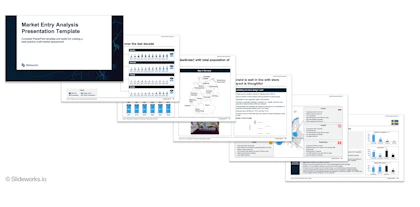
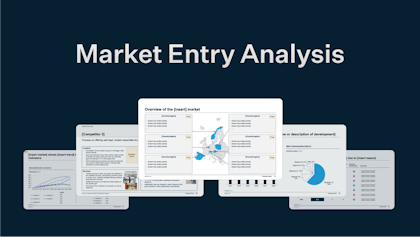
If you need to produce a market entry analysis report, the Slideworks Market Entry Analysis template gives you the complete six-section structure in a ready-to-use PowerPoint or Google Slides format. It includes all slide layouts for the country overview, individual deep-dives, and scoring matrix, as well as worked case examples showing how the structure is applied to real multi-market comparisons.

Explore the Market Entry Analysis Template →

Related articles

You may also want to explore further reading on both the overall market analysis work and tips and tricks for creating best practice presentations. Here are some articles, we’d recommend starting with:

You can find many more on our Resources page.