
Strategy

Product Strategy Deck: The MBB Consultant Cheat Sheet

Updated: Mar 11, 2026
Product Strategy Deck: The MBB Consultant Cheat Sheet
DISCLAIMER OF AFFILIATION: Slideworks is an independent entity and is not affiliated or endorsed by, or in any way officially connected with BCG, McKinsey or Bain. All references to these companies are for informational or comparative purposes only and does not imply any association with or endorsement by the aforementioned companies.

In our last article, we walked through what a product strategy is, why it’s important, and how management consultants like McKinsey and Bain consultants approach product strategy.


In this article, we’ve compiled a cheat sheet for creating your own, best-practice product strategy presentation. Where our previous article covers the full framework, this one gives you the practical tools: some constructive definitions, best-practice tips, and a checklist to pressure-test your deck before it goes to leadership.


What does a product strategy deck actually cover?

A product strategy deck outlines your core hypotheses on which customer you’re building for, how to create value for them, and in what priority that value should be built. It is distinct from a list of features or a roadmap — those are tactics. The strategy is the “why” that makes the tactics make sense.

A solid product strategy is necessary because it:

  • Ensures focus on a shared goal across the organization
  • Enables teamwork in an aligned, yet loosely coupled way
  • Makes it easier to prioritize day-to-day resources and say “no” to projects that don’t build toward the overall goal


Read our in-depth article to get a better understanding of the role a product strategy plays in the strategy hierarchy.

The 7-question structure MBB consultants use

The most effective product strategy presentations are built around seven core questions. If your deck can answer these questions clearly, you have a strong foundation:

  1. Where are we going?  → Mission, vision, strategic alignment objectives, success metrics
  2. Where do we see an opportunity?  → Market insights, user/customer insights, target audience, problem statement
  3. Is there space for us to play?  → Unfair advantages, competitive position, differentiation
  4. How will we win?  → Strategic product pillars, product positioning statement, core features and capabilities, brand, business model, pricing, initial go-to-market
  5. What is our plan to get there?  → Team and operating model, roadmap, North Star metrics, KPIs, OKRs or goals framework, measurement and reporting cadence
  6. What do the numbers look like?  → Financials and budget, investment need, risks and mitigations
  7. What are the immediate next steps?  → Next steps, key decisions, approval timeline

These seven questions will have varying weight and length of answers depending on what type of product you have, where you are in the product life cycle, what the surrounding organizational context is, and what type of product strategy deck you’re creating. 

For example, an established product already in stores may focus less on fundamentals like brand and value proposition and more on reaching new customers, adding new variants, or changing elements of production to e.g., lower costs. A not-yet-started corporate venture or completely new product line on the other hand will need in-depth answers to all these questions.

The implicit assumption in the first situation is that all questions have already been answered so small tweaks are enough.


Product strategy vs. go-to-market strategy: What’s the difference?

Product strategy and go-to-market strategy are closely linked but distinct. Confusing them is one of the most common mistakes product teams make when building their decks.

The three archetypes of product strategy presentations

Not every deck should be a full end-to-end strategy document. Instead, the format should match the purpose. Here are three archetypical types of product strategy decks:

  • Weekly/quarterly update: Shorter, to-the-point decks focused on specific initiatives and status updates. Recurring in nature, with an emphasis on tactics and plan.
     
  • (Annual) product strategy for an existing product: Often longer decks spending more time on big-picture thinking and where the product overall is headed. A mix of direction-setting and tactical updates.
     
  • Full product strategy for a new product or venture: Longer decks that include all aspects of a product strategy; strategic rationale, full investment need, and a comprehensive view of the opportunity.

6 best-practice tips from McKinsey, BCG, and Bain consultants

These are the principles that separate a good product strategy deck from a great one, based on our years of building and advising on product strategies at McKinsey, BCG, and Bain and beyond:

  1. Remember the strategic context.  
    Place your product strategy in the broader organizational strategy and link it to a specific business outcome and role — growth engine, new market entry, cost-reduction lever. A strategy that exists in a vacuum won’t survive its first leadership review.
     
  2. Make real strategic choices.  
    Pressure-test your strategy by articulating which initiatives, customers, or features you will specifically not spend time on. If your strategy doesn’t say no to anything, it’s not really a strategy.
     
  3. Build on a strong analytical foundation.  
    Gut feel isn’t enough. Ground your strategy in data; market sizing, customer research, competitive analysis, and internal performance metrics.
     
  4. Frame objectives as problems to solve, not features to build.  Translate objectives into strategic initiatives that emphasize solving problems rather than shipping features. This keeps teams focused on outcomes, not outputs.
     
  5. Set up systematic ways to monitor and potentially change course.  Build in a mechanism for reviewing and adapting the strategy with key stakeholders so it doesn't come as a surprise or become a big discussion once inevitable course corrections are needed.
     
  6. Never underestimate how you communicate your strategy.  
    Keep it clear, concise, and relevant. ALWAYS align it with key stakeholders early and often. The best strategy in the world fails if the people who need to act on it don’t understand or believe in it.


The best-practice product strategy checklist

Use this checklist to audit your deck before it goes to leadership. It goes into the six areas above in a straight-forward manner: strategic context, focus and strategic choices, analytical foundation, strategic initiatives, monitoring and managing, and communicating your strategy.

Download a free copy of the product strategy checklist here to use in your daily work. Download now

✅  1. Strategic context

Overall goal: Understand and embed your product in the broader organizational context to ensure optimal chances of support from stakeholders and ultimately success.


✅  2. Focus and strategic choices


✅  3. Analytical foundation and insights


✅  4. Strategic initiatives


✅  5. Monitor and manage


✅  6. Communicating your strategy

Get your own free copy of the product strategy presentation checklist here Download now

Take it further

If you want to go deeper on the framework behind this cheat sheet, read our full guide: How to Create a Great Product Strategy: What Can We Learn From McKinsey?

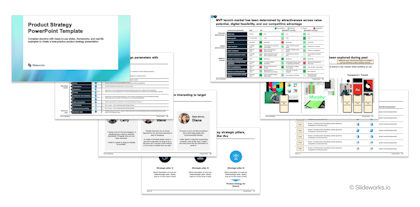
And if you’re ready to build your deck, our McKinsey-style Product Strategy template includes 500+ slides, three Excel models, and five real Fortune 500 examples - so you can focus on your strategy, not the formatting.

Frequently Asked Questions (FAQ)

What is a product strategy cheat sheet?

A product strategy cheat sheet is a condensed reference guide that captures the key structure, questions, tips, and checklist items needed to build a best-practice product strategy deck. It’s designed to be used alongside, not instead of, a full product strategy framework.
 

What should a product strategy deck include?

A best-practice product strategy deck should answer seven key questions: where you’re going, where you see an opportunity, whether there’s space to play, how you’ll win, what your plan is, what the numbers look like, and what the next steps are. It should also include a clear strategic context, well-defined focus and choices, a strong analytical foundation, and concrete strategic initiatives.
 

How long should a product strategy presentation be?

The length depends on the type of deck. A weekly or quarterly update can be 5–10 slides. An annual strategy refresh for an existing product is typically 15–25+ slides. A full product strategy for a new product or venture may be 30–100+ slides, often accompanied by a shorter executive summary version.
 

What is the difference between a product strategy and a product roadmap?

A product strategy defines the “why” and the “what” at a high level — the vision, the customer, the value proposition, and the strategic choices. A product roadmap is more tactical: it covers the “how” and “when,” with specific features, releases, and timelines. The strategy drives the roadmap, not the other way around.


What makes a product strategy “McKinsey-quality”?

MBB-quality product strategies are grounded in rigorous analysis, make explicit strategic choices (including what they will not do), connect clearly to the broader business context, and are communicated with clarity and precision. They use best-practice approaches to slide writing and presentation building to make sure key points stand out and the whole deck is tailored to leadership audiences.